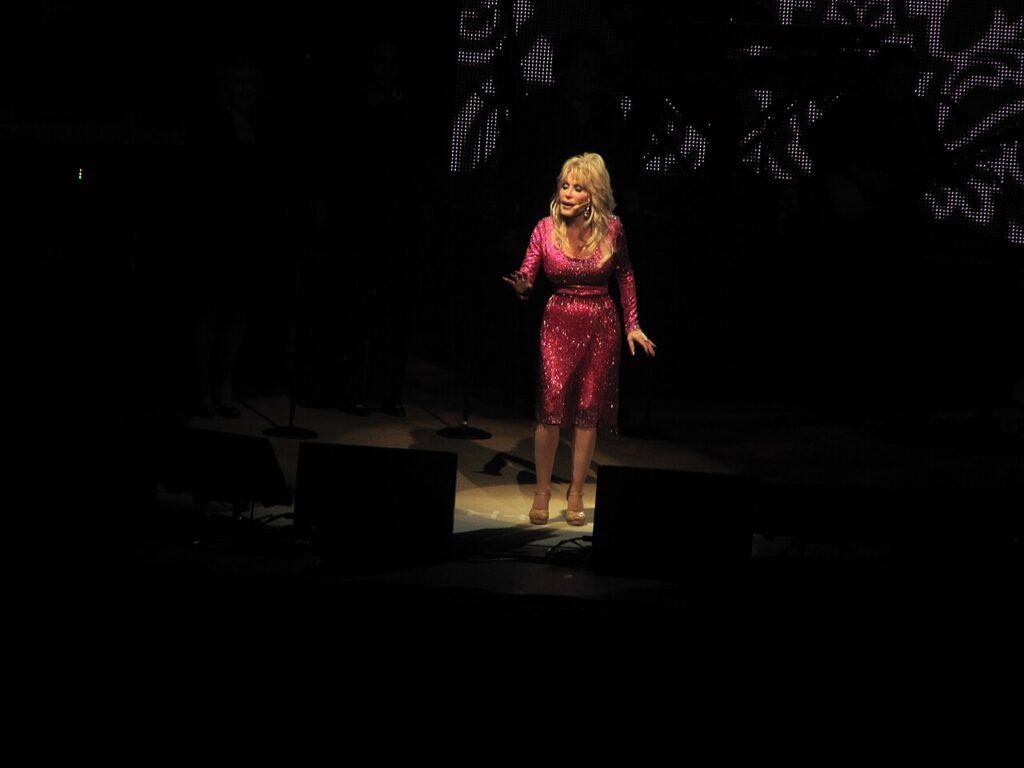
Dolly Parton died on August 25, 2026, in Nashville. She was 80. Her family said she died peacefully after a brief battle with cancer, at Vanderbilt-Ingram Cancer Center, surrounded by loved ones. The tributes came from everywhere — Taylor Swift, Miley Cyrus, the UK Parliament, which noted her Imagination Library and the hundreds of millions of books it has put into children’s hands.
She was one of the most decorated figures in American music: singer, songwriter, actress, businesswoman, philanthropist. But if you want to understand how she got there — and why she stayed in control of her own career for six decades — there is one night in 1974 that tells you almost everything.
It started with a phone call. Elvis Presley wanted to record her song.
The song was “I Will Always Love You,” and Parton had written it the year before, in 1973, sitting by the fireplace at her home in Antioch, Tennessee. She was trying to leave Porter Wagoner’s television show, where she had performed for seven years, and Wagoner would not hear her out. So she did the thing she knew how to do. She wrote him a song.
“I absolutely remember where I was sitting, the time of night and everything,” she told CMT years later. “I was having so much trouble leaving Porter’s show… We’d had great success, [but] we had a lot of problems. We didn’t get along very well, but we loved each other, too… But he wouldn’t hear me out. He just couldn’t listen to me, and so I thought, ‘The only way I’m gonna express what I feel and have him understand is to write a song.'”
She wrote it in a couple of hours. And in the same sitting, she wrote “Jolene.” Two of the most famous songs of the twentieth century, written on one evening — one of them a goodbye.
The next day she walked into Wagoner’s office and sang it to him, just her and her guitar. He cried. He told her she could go, on one condition: he got to produce the record. She recorded it at RCA Studio B in Nashville on June 12, 1973. RCA released it as a single on March 11, 1974, and that June it reached No. 1 on the Billboard country chart. It would reach No. 1 again in 1982, in a new recording for the film The Best Little Whorehouse in Texas.
Then came Elvis. He loved the song and wanted to record it, and his producer invited Parton to the studio session. She was, in her own words, “out of my mind with excitement.”
The afternoon before the session, the phone rang again. This time it was Colonel Tom Parker, Elvis’s manager. He had a rule, and he explained it plainly: Elvis didn’t record anything unless his camp got the publishing — or at least half of it.
Publishing is the songwriter’s share. It is the money a song earns every time it is sold, played, licensed or covered — forever. Parker was asking Parton to hand over half the ownership of her own composition, permanently, in exchange for one Elvis recording. It was a standard demand from his camp, and almost everyone agreed to it, because the logic seemed obvious: half of an Elvis hit beats all of anything else.
Parton said no.
“I said, ‘Well, now it’s already been a hit. I wrote it and I’ve already published it, and this is the stuff I’m leaving for my family when I’m dead and gone. That money goes in for stuff for my brothers and sisters and nieces and nephews, so I can’t give up half the publishing,'” she recalled in a 2006 CMT interview. Parker replied, “Well then, we can’t record it.”
She had her own publishing company, and she knew exactly what she was protecting. In her 1989 Interview cover story she put it simply: as the writer, she wouldn’t give Colonel Tom Parker the song, because she didn’t want to start doing that — “you know leavin’ myself open — because then everybody would record it.”
It broke her heart. She has said so herself, many times, without any embarrassment about it. “Of course, I cried all night about that,” she told Howard Stern in 2023. “I wanted to hear Elvis sing it, and it broke my heart.” But she added the sentence that explains her whole career: “I had to keep that copyright in my pocket. You have to take care of your business. Everybody’s going to use you if they can. These are my songs. They’re like my children. And I expect them to support me when I’m old.”
Elvis never recorded “I Will Always Love You.” But he never quite let go of it either. Parton later said that Priscilla Presley told her Elvis sang the song as the couple walked down the courthouse steps after their divorce — her goodbye song, sung by the King to the wife he was parting from. Learning that, she said, touched her deeply.
For almost twenty years, the refusal looked like a footnote — a brave, slightly sad story about the one that got away. Then, in 1992, Whitney Houston recorded the song for the film The Bodyguard.
Houston’s version, released on November 2, 1992, spent a then-record 14 weeks at No. 1 on the Billboard Hot 100, topped the charts in 34 countries, and has sold more than 24 million copies — the best-selling single by a female artist in history, according to Guinness World Records. It won Record of the Year and Best Female Pop Vocal Performance at the Grammy Awards on March 1, 1994. And in a small, perfect piece of symmetry, Parton herself presented one of those Grammys to Houston on the night.
“I was so thankful that I had made that choice,” Parton said, “because I made a lot of money off of Whitney’s.”
But the money is not really the point. The point is what the refusal cost her in the moment and what it proved about her. She was 28 years old, a rising country star, saying no to the most powerful act in music — to the King, and to the man who controlled him — because she understood something most artists learn too late: the song is the business, and the business is yours to keep.
She kept it all — her songs, her name, her terms. She built Dollywood, she built the Imagination Library, she wrote more than 3,000 songs, and she did it as the owner of her own work, not as someone else’s property. When she died, her husband of 59 years, Carl Dean, had already been gone for a year and a half. She left behind a catalogue that will pay her family for generations — the same family she was thinking about when she told Colonel Parker no.
Elvis never sang her song. Whitney did, and the world sang along. And the woman who wrote it in one evening by a fireplace in Tennessee, as a way of saying goodbye to a man who wouldn’t listen, turned out to be right about the only thing that mattered: some things are worth more kept than sold.
Sources
- USA Today — “Dolly Parton dead at 80. Taylor Swift, Miley Cyrus pay tribute” — 26 August 2026
- dollyparton.com — “Official Announcement: Dolly Parton Passes Away at 80” — 25 August 2026
- Interview Magazine — “That Time When Dolly Parton Refused Her Song Rights to Elvis” (July 1989 cover story, revisited)
- American Songwriter — “The Story Behind Why Dolly Parton Refused to Let Elvis Presley Record ‘I Will Always Love You'”
- Guinness World Records — “Best-selling physical single by a solo artist (female)” (Whitney Houston, 24,000,000 copies)
- Wikipedia — “I Will Always Love You” (Dolly Parton original and Whitney Houston version; chart history and Grammy Awards)
- The Dolly Parton Discography — “I Will Always Love You (1974 single)” (recording date June 12, 1973; release March 11, 1974; No. 1 June 1974)
- Wikipedia — “Dolly Parton” (born January 19, 1946; more than 3,000 songs written; 100 million records sold)